
Land use
Use the action hierarchy as a working model
The hierarchy of measures is a well-known model in environmental work and development projects. In this guide, the model is used as a practical tool for more nature-friendly land use in holiday home development.
The hierarchy of measures can be used as a simple working model for both business actors and the municipality. The model shows the order in which development measures should be considered:
Avoid
Limit
Restore
Compensate
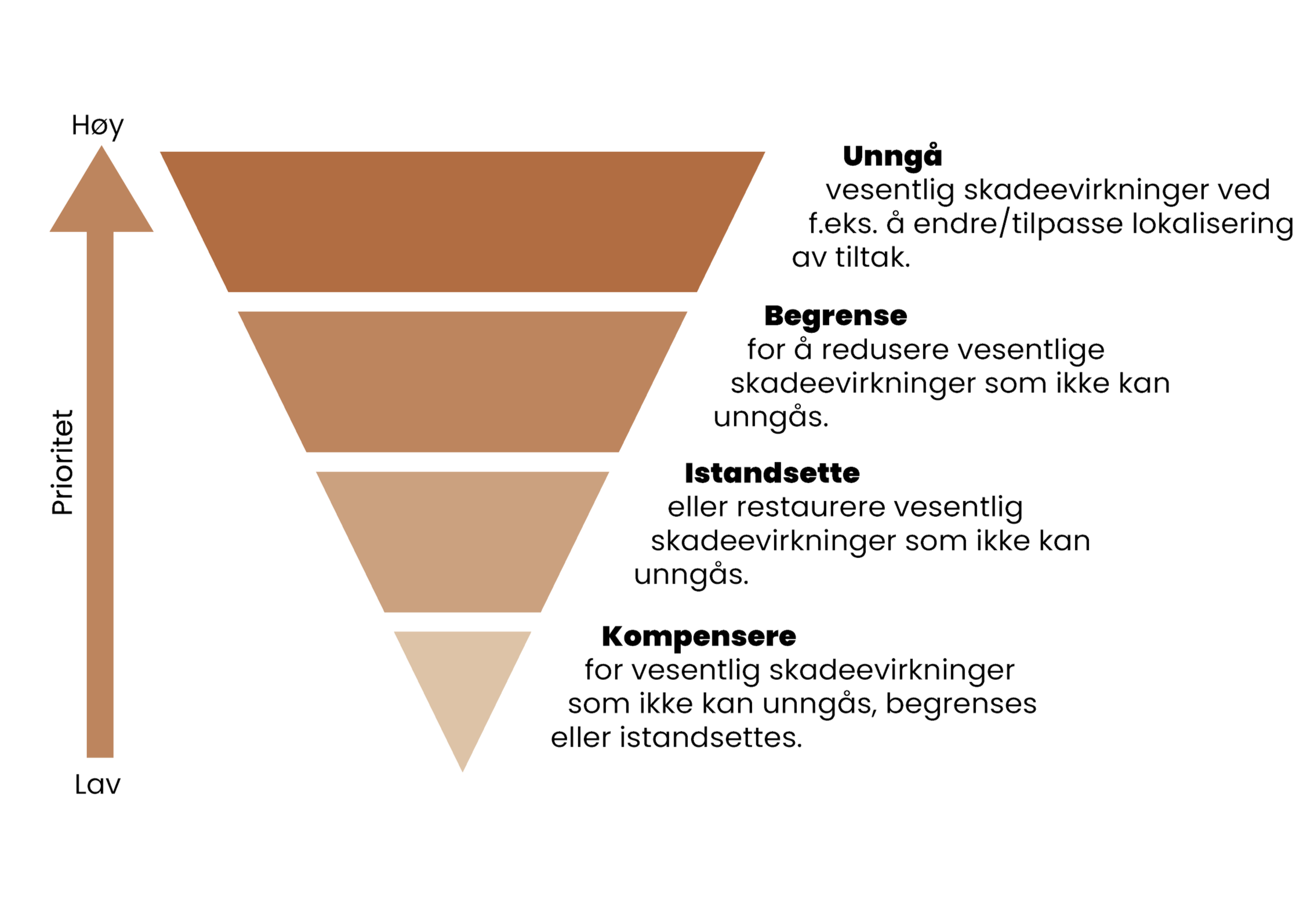
Figure: The action hierarchy.
The most important thing is to avoid new interventions in intact and vulnerable nature. If interventions cannot be avoided, they must be limited through good planning and careful implementation. Temporary interventions should be restored. Compensation should only be considered when it is not possible to avoid, limit or restore nature interventions sufficiently.
For municipalities, the action hierarchy can be used in planning work, planning review, assessment of land reserves and dialogue with developers. For developers and local businesses, the model can be used in early project development, regulation, design, construction phase and operation.
1. Avoid
The first and most important step is to avoid interference with nature. This is particularly true with regard to location.
Municipalities and developers should consider whether new holiday homes can be located in already developed or degraded areas, rather than opening up new natural areas. This may also involve reviewing existing plans and considering whether certain areas should be removed or changed.
Landscaping can be an important tool. Many municipalities have large land reserves for holiday homes. If these are located in intact or vulnerable nature, further development can result in significant loss of nature.
Mapping of grey areas should be included in this work. Grey areas can be former landfills, old construction sites, abandoned industrial areas or other heavily impacted areas. Such areas may in some cases be better suited for development than untouched nature.
Work questions:
Are there alternatives to building in intact nature?
Can the need be solved through densification or better use of existing areas?
Are there gray areas or degraded areas that can be assessed?
Are natural values and vulnerability well enough mapped?
Should existing plans be reviewed before new areas are opened?
2. Limit
Once the location has been determined, interventions must be limited.
Good planning can reduce environmental damage. It can also be cheaper than repairing damage afterwards. Environmental considerations should therefore be a common thread throughout the project, from zoning and design to the construction phase and finished area.
In practice, this involves limiting land use during the construction phase, controlling machinery use, clearly marking construction areas, and taking care to ensure that vegetation, soil, streams, rocks, and trees are not affected.
Topsoil is an important resource. Soil and vegetation cover that must be removed should be temporarily stored and reused in the area. Local soil, heather, shrubs and vegetation peat can contribute to faster revegetation and better ecological results.
Training of the client and contractor is also important. NINA can offer a "Green Course", where ecological knowledge and practical construction experience are combined.
Work questions:
How can the construction area be clearly demarcated?
Which trees, streams, rocks and vegetation areas should be preserved?
How should topsoil be removed, stored and reused?
How can heavy machinery be kept away from vulnerable areas?
Do the contractor and developer have enough knowledge about environmental considerations?
3. Restore
Some interventions occur during the construction phase. These may include rigging areas, temporary access roads, bulk storage or roadways.
Such interventions should be restored before the construction phase ends. This requires that restoration is planned from the start. Topsoil must be preserved. The terrain must be reshaped. Vegetation must be restored where possible.
Restoration may also be relevant in older holiday home areas. This may involve removing or re-routing paths, narrowing wide thoroughfares, closing parallel paths or repairing wear and tear.
Restoration can never replace pristine nature. Its most important role is to improve areas that have already been damaged, and reduce the lasting effects of interventions that have already been made.
Work questions:
What temporary interventions will occur during the construction phase?
How will rig areas and construction roads be restored?
Are top materials stored so they can be used in the restoration?
Are there any old interventions or wear and tear that can be repaired?
How will traffic be managed after the restoration is complete?
4. Compensate
Compensation is the last step in the hierarchy of measures. It should only be considered when it is not possible to sufficiently avoid, limit or restore environmental impacts.
Compensation means that the loss of natural values is replaced through the improvement, restoration or protection of nature elsewhere. The goal is to reduce the overall burden on nature.
In Norway, nature compensation is still under development as an instrument. There is a need for clearer legal frameworks, methods and standards for how such measures should be implemented and followed up. Therefore, compensation should not be used as a simple solution to legitimize new interventions in nature.
In the case of holiday home development, compensatory measures may include, for example, the restoration of bogs and wetlands, the removal of old technical interventions or the strengthening of ecological connections in the landscape.
Work questions:
Have all options for avoidance, mitigation and restoration been considered first?
What natural values are being lost?
Can the loss be documented through natural resource accounting or other mapping?
Where can compensatory measures have the greatest ecological effect?
How should the measures be followed up over time?
Visitor management
Holiday home development also affects the areas surrounding the development itself. More holiday homes often result in more traffic on paths, ski slopes, roads, parking lots and exit areas.
Therefore, visitor management should be part of the work on land use.
Good visitor management is about providing users with good experiences while protecting vulnerable natural areas, wildlife and local user interests. This may involve channeling traffic, reinforcing existing paths, avoiding development in vulnerable areas and planning outdoor infrastructure before new holiday home areas are established.
Work questions:
Where will traffic from the holiday home area go?
Which paths, trails and exit areas will see increased use?
Is there vulnerable nature or wildlife that should be protected?
Can traffic be channeled to areas that can handle more use?
Can existing paths and trails be reinforced before new ones are established?
How are local uses, agriculture, hunting and grazing interests affected?
Is there a need for a visitor strategy or a comprehensive plan for outdoor infrastructure?
How should traffic and wear be monitored over time?
Checklist for municipalities and developers
For municipalities
Do we have an overview of the land reserve for holiday homes?
Do we know which areas are in intact or vulnerable nature?
Have we mapped grey areas and other degraded nature?
Should existing plans be reviewed through plan review?
Do we have knowledge about natural values, ecological condition and vulnerability?
Are natural resource accounting or land accounting used as part of the decision-making basis?
Is visitor management connected to holiday home development?
For business
Are natural values and vulnerability mapped early enough?
Can the project be located in an already affected area?
Can land encroachment, roads and parking be reduced?
How should soil, vegetation and waterways be taken care of?
Is the construction area clearly demarcated?
Do the contractor and the client have a common understanding of environmental considerations?
How should temporary interventions be restored afterwards?