
Gathering key players on Stokkøya
Stokkøya is a clear example of how a good place to live is a good place to visit. For almost two decades, brave entrepreneurs have further developed a traditional coastal community that is attractive to both residents and visitors. Now they are leading the way in utilizing gray land.
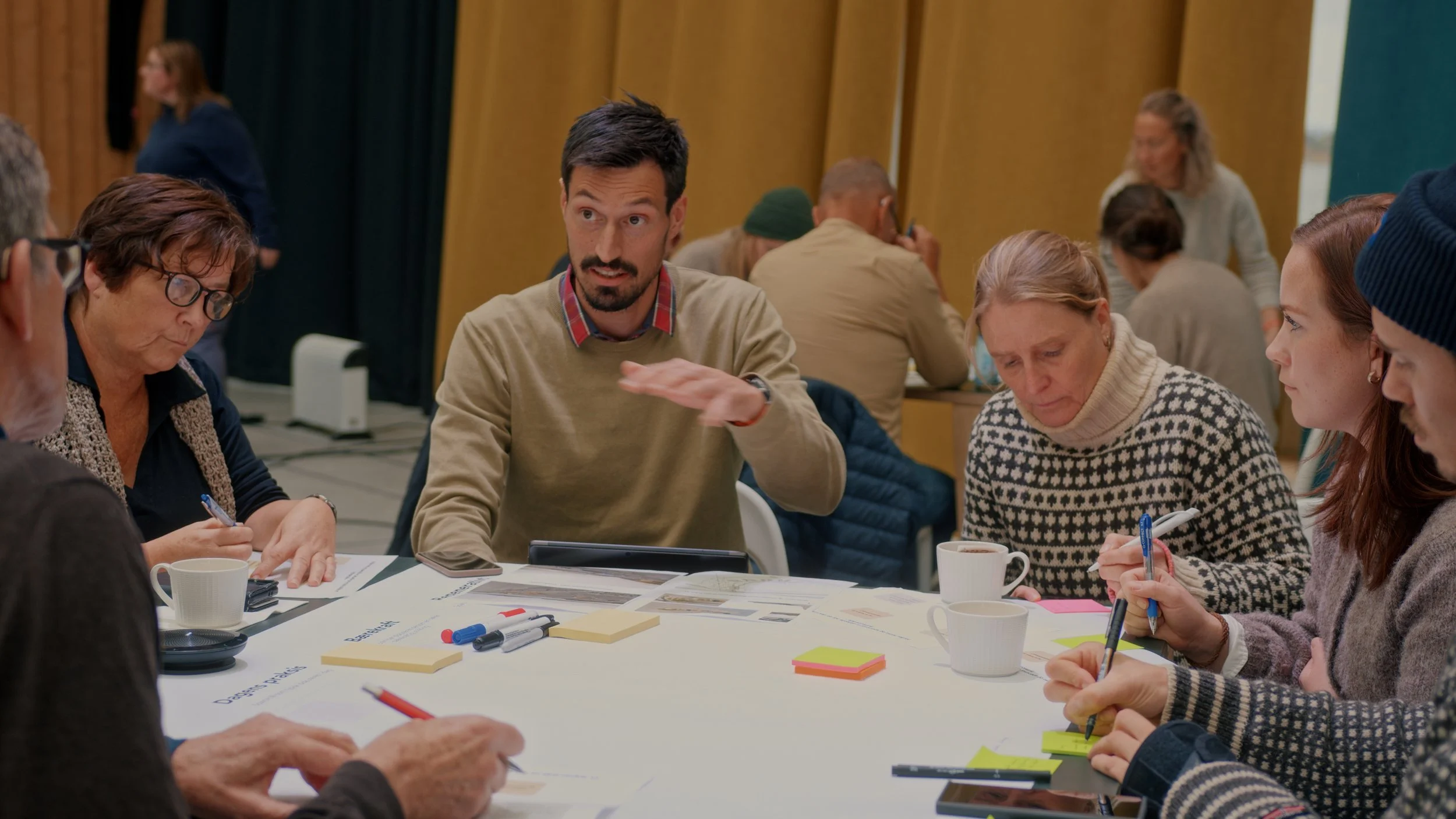
Photo: Next Hero
About the pilot
Over the past 20 years, Stokkøya has transformed from a community threatened by displacement to an attractive destination that attracts both international guests and recreationalmakers. An important premise for the development has been to establish jobs, housing and housing for an increased number of permanent residents.
The holiday home area on the island is characterized by low land use, where the holiday homes are adapted to the terrain through architecture and alternative infrastructure – and not the other way around. Now Stokkøya is relevant in showing how one can utilize gray land. In a large area that was left behind by a major road development, plans are being made for both homes and holiday homes.
In the pilot, Stokkøya was used as a case and practical framework to test how new tools for dialogue and planning can be developed. The pilot was based on Stokkøya as a place, but had a broader purpose. We want to explore which questions should be asked early in the planning of holiday home areas.
An important starting point was that holiday home development affects many considerations at the same time. It is about nature, land use, local communities, place qualities and value creation. It is also about resource use, energy, materials and infrastructure.
The Stokkøya pilot investigated how municipalities, developers, businesses and professional communities can collaborate earlier and better in the development of holiday home areas.
Relevance
The goal was to use Stokkøya as a good case, and as a "backstage" to test which themes, questions and dialogue forms can be included in a digital toolbox for more nature- and socially adapted holiday home development.
The pilot was based on three main questions:
How can holiday home development take greater account of nature?
How can it take greater account of the local community?
How can resources be kept in the cycle longer?
Participants worked on these questions along three development levels: Current practice, sustainability and regenerative development. In this way, the workshop was used to test how dialogue can help raise competence, ambition and shared understanding in a development project.
The process
In November 2023, SOURCE invited stakeholders from Åfjord and Osen municipalities to a professional gathering on Stokkøya. Participants came from the municipality, business and the knowledge community.
The gathering used both the previous development of the site and the ongoing plans for new residential and recreational areas as a framework for inspection, discussions and a workshop. This gave participants a concrete starting point for exploring how interdisciplinary collaboration can contribute to more sustainable and regenerative solutions.
In the workshop, participants were placed in groups across disciplines and backgrounds. The goal of the session was to uncover any barriers and challenges that exist when starting to plan an area for development. How easy or difficult is it to develop plans, ideas and solutions - more sustainable than the "usual", classic method? And how difficult is it to take a development project beyond sustainability and to the regenerative level?
Result
The workshop provided a concrete basis for further development of SOURCE's digital toolbox. Participants identified themes and questions that can be used in early dialogue between municipalities, developers, professional communities and affected actors.
An important result was that the dialogue must be structured. When a holiday home area is planned, many actors with different expertise, roles and interests meet. Without a clear framework, the conversation can easily become fragmented. A dialogue tool can help the actors not only talk to each other, but with each other.
The workshop also made it clear that holiday home development must be considered across multiple themes. Nature, local communities and resource use cannot be treated as separate issues. Land use, biodiversity, local value creation, housing diversity, energy, infrastructure, reuse and the sharing economy are interconnected.
For SOURCE, the Stokkøya pilot was therefore important as a method test. It showed which questions are relevant in the early phase, and how the questions can be used to open a broader and more ambitious conversation about holiday home development.
A significant input from the workshop was: "Now we have just realized that it is wise to become sustainable. Then you say that we also have to be regenerative. It is not so easy for a small player to have to deal with this transition."
The quote shows an important lesson from the pilot. To succeed with restructuring, it is important to make new concepts, requirements and working methods understandable and applicable to the actors who will use them in practice.
Next step
The work from Stokkøya is used as a basis for the development of the academic themes and the associated digital toolbox at Recabin.
The themes and questions from the workshop have been further developed so that they can be used by municipalities, developers and other stakeholders in future projects.
[INSERT LINK TO “Tutor”].