
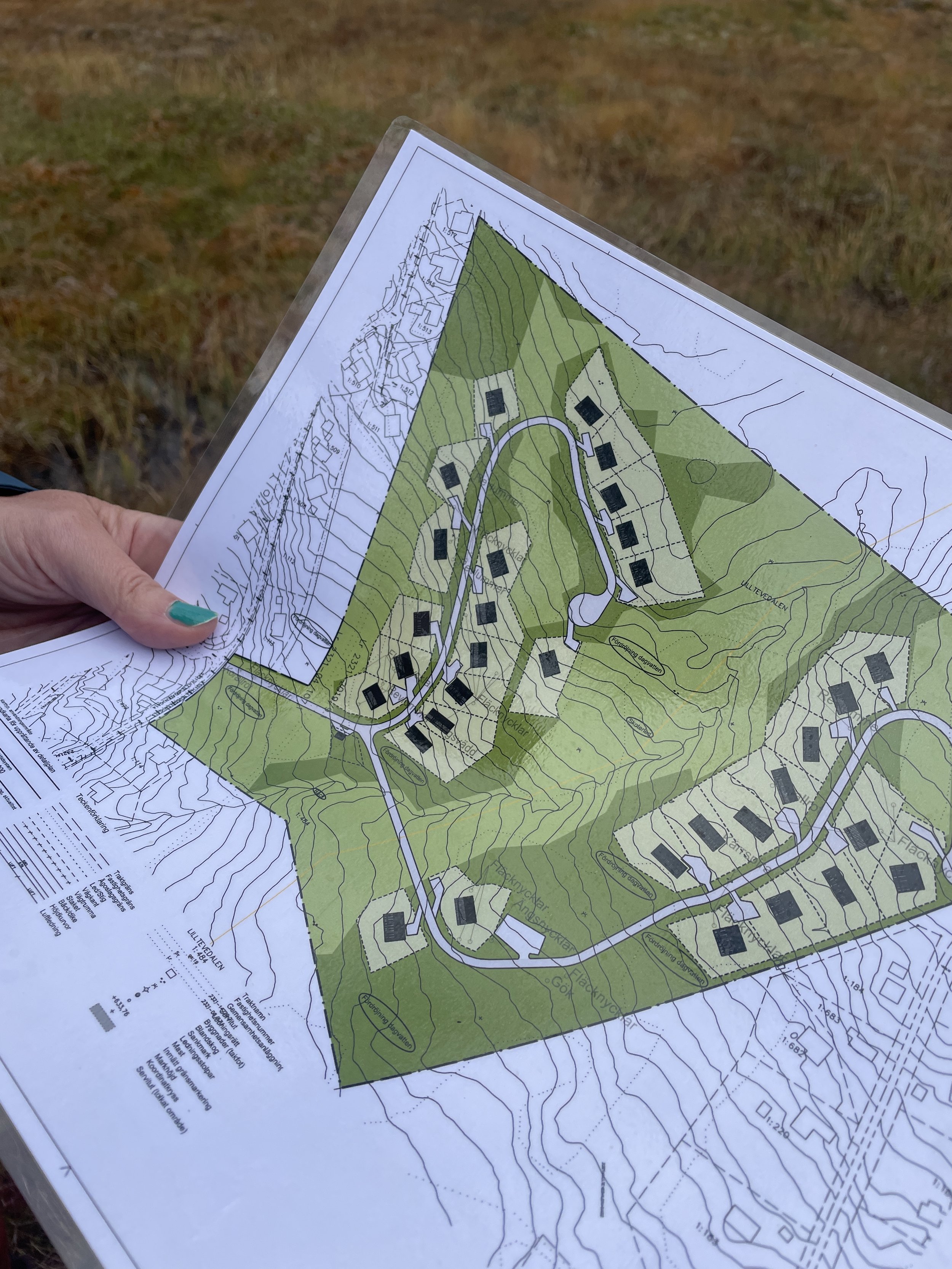
Where can we build to take the most consideration for nature?
Did you know that cabin construction accounts for about a quarter of planned destruction of natural areas in Norway? At the same time, large parts of the land reserve are located in intact nature – and when we build there, we lose irreplaceable natural values.
But what if we could turn this around? What if cabin construction could help improve nature – not degrade it?
Concepts related to environmental considerations
-
Areas that have been heavily altered or damaged by human activity and have low ecological value.
-
Overview of the condition and development of nature in an area, including land use and natural resources.
-
Active measures to restore or improve degraded ecosystems.
-
New development occurs without reducing the total natural area, often through the reuse of already affected areas.
Use of “gray areas”
One solution is to build where nature is already degraded – so-called grey areas . These are areas with low ecological value, for example:
Disused landfills or landfills
Old industrial areas
Residual areas along roads or railways
Unused commercial properties
By building on such areas, combined with restoration measures, we can create attractive recreational home areas that provide more natural diversity than before.
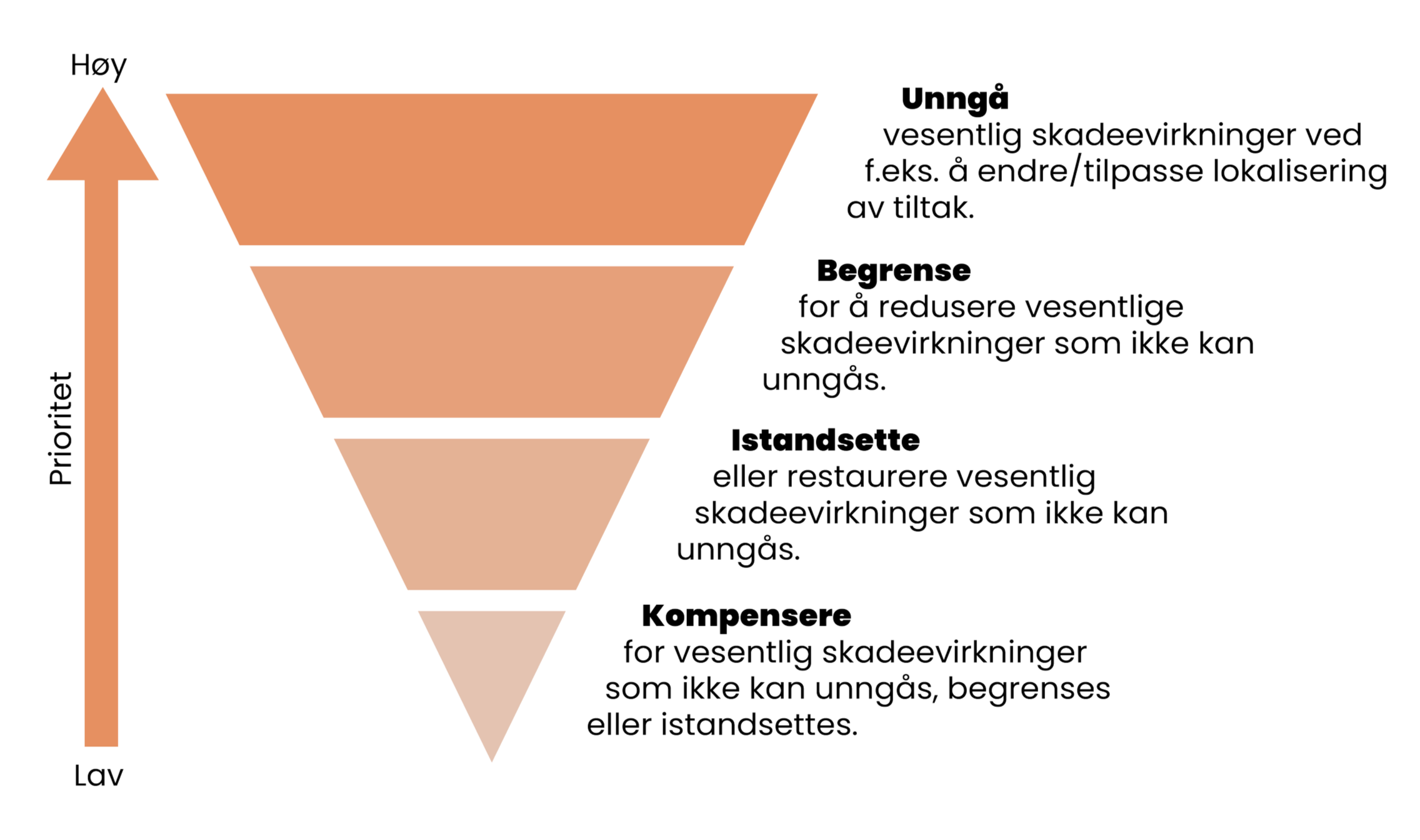
The hierarchy of measures – the path to environmentally friendly construction
To ensure that development results in the least possible loss of nature – and preferably an improvement – we can follow the hierarchy of measures:
Avoid damage to nature where possible
Limiting unavoidable interventions
Restore areas that are damaged
Compensate for losses where restoration is not possible
The first three steps are crucial to achieving nature-positive results.
Why restore nature?
Restoration means actively improving the condition of an ecosystem. The goal is to strengthen nature's ability to deliver natural goods – everything from clean water to great nature experiences.
Examples of restoration measures:
Closed ditches in the marsh
Removing old construction roads
Plant native trees and shrubs
Restoring natural water flow
Restoration can never replace pristine nature, but it can make a big difference in areas that are already affected.
-
Blumentrath, S., Simensen, T. & Nowell, M. 2022. Mapping of land reserves for recreational homes in Norway. NINA Report 2171. Norwegian Institute for Nature Research
Farstad, M., & Rye, JF (2013). Second home owners, locals and their perspectives on rural development. Journal of Rural Studies, 30, 41-51.
Gundersen, V. & Singsaas, M. 2020. Management of considerate traffic in wild reindeer areas. Journal Utmark (peer-reviewed, published March 2021).
Gundersen, V. & S. Rybråten. 2022. Differing perceptions and tensions among tourists and locals concerning a national park region in Norway. Journal of Rural Studies 94, 477–487. https://doi.org/10.1016/j.jrurstud.2022.07.017
Gundersen, V., Singsaas, M., Grønn, JF, Köhler, B. & T. Simensen. 2023. Tradition and destination - a study of recreational homes, traffic and future visions on the Hardangervidda plateau. NINA Special Issue 83. Norwegian Institute for Nature Research. https://hdl.handle.net/11250/3077502
Holsen, T., 2022. Spatial planning principles and traditions in planning densely populated recreational areas. Kart og Plan 115, 29-64.
Landa-Mata, I., Dybedal, P., Gundersen, V., Knapskog, M., Gundersen, F., Haukeland, JV, Stokke, KB, Stange, E. & GR Pettersen. 2024. Just visiting? Methods for integrating visitor management into planning work. TØI report: 2018/2024: 148p. ISBN 978-82-480-2132-2.
Langdalen, E. (1980). Second homes in Norway – a controversial planning problem. Norsk Geografisk Tidsskrift – Norwegian Journal of Geography, 34, 139–144. doi: 10.1080/00291958008552059
Lyngstad, A., Simensen, T. & Kyrkjeeide, MO 2023. Nature accounting for a cottage village. Otrosåsen at Hovden in Bykle municipality. NINA Report 2354. Norwegian Institute for Natural Research.
Overvåg, K., & Berg, NG (2011). Second homes, rurality and contested space in Eastern Norway. Tourism Geographies, 13(3), 417-442.
Singsaas, M., Grønn, JF & V. Gundersen. 2024. Visitor Management in Second-Home Municipalities – Tensions Between Tradition and Destination. Maps and Plans 117 (1): 139–156. DOI: https://doi.org/10.18261/kp.117.1.8
Skjeggedal, T., Flemsaeter, F., & Gundersen, V. (2021). Land use planning in disputed mountain areas: conflicting interests and common arenas. Journal of Environmental Planning and Management, 64(7), 1133-1155. https://doi.org/10.1080/09640568.2020.1812379
Slätmo, E., Ormstrup Vestergård, L., Lidmo, J., & Turunen, E. (2019). Urban–rural flows from seasonal tourism and second homes: Planning challenges and strategies in the Nordics.
Slätmo, E., Vestergård, LO, & Lidmo, J. (2020). Compact cities trigger high use of second homes in the Nordic Region.
Statistics Norway 2023. https://www.ssb.no/bygg-bolig-og-eiendom/faktaside/hytter-og-ferieboliger
Short films from the theme
SOURCE has tested and documented solutions that can make holiday home development more nature-positive. Here you will find a selection of film clips from the Green Cabin Lab event.
What are gray areas and what can we do about them?
Trond Simensen, researcher at NINA (Norwegian Institute for Natural Research) and Narve Skårsmoen, master's degree in architecture, NTNU.
How to get started with the work
Map gray areas
Create an overview of areas in the municipality that have been greatly altered or degraded, and assess the potential for development and restoration.
Look at old industrial areas, mass roofs, residual areas and other unused surfaces.
Review the plans
Check whether planned cabin construction can be moved to grey areas or to densify existing fields.
Document natural values before construction
Conduct field surveys to map species, habitats and ecological condition in and around the area.
Plan for nature considerations during the construction phase
Reduce earthworks, preserve vegetation, and maintain natural drainage systems.
Involve professionals early, and consider courses and training for contractors.
Think landscape, not just empty space
Prioritize development where infrastructure already exists, and avoid the most vulnerable areas.
Benefits for municipalities and businesses
Building on grey areas and combining this with restoration can:
Reducing land use conflicts
Preserving biodiversity
Create attractive areas with high experience value
Provide competitive advantage in a market with increasing demands for sustainability