
Resource usage
Holiday homes take up a lot of resources. This includes land, materials, energy, infrastructure and emergency preparedness. At the same time, many cabins remain empty for large parts of the year.
This makes circular resource use a central theme in holiday home development.
A circular perspective shifts the focus from new development to better use of what already exists. Existing cabins, older buildings, equipment, facilities and infrastructure can be used more, shared better and managed over a longer period of time.
This is not just about how the cabin is built. It is also about how often it is used, how it can be adapted to new needs, and how values that are already invested in buildings and places can be better preserved.
In many districts, there are also buildings that could be used much more than they are today. Increased use of existing buildings can help preserve values. It can also provide new income, lower costs, more local services and new jobs.
This guide is about how holiday homes can be developed, used and managed so that resources are kept in circulation longer, and so that the holiday home's overall footprint is smaller.
Terms and definitions
-
An economic model where materials and products are kept in circulation with the highest possible value, while reducing waste and resource use.
-
Actual use of existing holiday homes and buildings. By increasing the intensity of use, it is possible to meet demand without taking up new, untouched natural areas. Higher use helps to preserve existing investments and reduces the environmental impact that results from new construction.
-
Establishing sharing solutions (e.g. condominiums, equipment banks and shared services) reduces the need for duplicate areas and resources.
-
This involves taking advantage of underutilized buildings in the districts – such as barns, former schools or old service buildings – and adapting them for new recreational purposes.
-
Simplified holiday home concepts emphasize smaller size, smarter floor plans and more reversible building solutions, often based on low-tech and local materials.
-
Holiday homes designed to be dismantled, moved or adapted over time, allowing building parts and materials to be reused instead of discarded. Helps reduce waste, limits permanent landscape interventions and supports circular technical material cycles.
-
Based on the use of locally sourced materials, regional craftsmanship, local services and short value chains. Strengthens local economies, reduces transport-related emissions and provides greater transparency and ethical control in production and supply chains.
-
Refers to the total energy use associated with the extraction of raw materials, processing, production and transportation of building materials. By reducing embodied energy – through reuse, smaller buildings and materials with a low degree of processing – the environmental impact in vulnerable landscapes can be significantly reduced.
-
Quantity, type and properties of materials used in holiday homes and associated infrastructure. Choosing renewable, non-toxic, separable and maintenance-friendly materials increases the possibilities for reuse and reduces the burden on the natural environment.
-
Includes all greenhouse gas emissions that occur through material production, transport and construction processes.
-
A method that involves including all stakeholders in dialogue at an early stage, to highlight multiple perspectives, minimize negative environmental impacts, and respect the character of the place and those who already live there.
-
An industrial process in which used products or components are collected, disassembled, inspected, repaired and reassembled to achieve the same (or better) quality, performance and warranty as a similar new product.
Theme and problem
Holiday homes tie up large resources. Materials, energy, technical infrastructure and land are included in each individual building. Once the cabin is built, there is therefore great value in both the building and the surrounding area.
How these values are used over time is of great importance. A cabin that is used frequently, maintained regularly and can be adapted to new needs provides better resource utilization. A cabin that is empty for much of the year has a high footprint per day of use. It still requires roads, water and sewage, electricity, sanitation and emergency preparedness.
Using a lot is good
Intensity of use therefore becomes an important part of resource use. How often is the holiday home used? How many people have access to it? Can it be used for several seasons? Can it be shared, rented out or included in joint solutions? Such questions affect both environmental impact, local value creation and the need for new development.
A circular perspective shifts the focus from volume and new production to management, intensity of use and long-term value retention. It provides a different way to assess holiday homes. The value lies not only in what is built new. It also lies in what has already been built, and how it is used, maintained and developed over time.
Holiday homes often change function throughout their lifespan. Many start as weekend homes. Later, they can be used for larger parts of the year. Some eventually take on the character of long-term residences. This often happens gradually. Therefore, holiday homes should be understood as buildings in development, not as finished products.
This requires flexibility. Buildings that can be maintained, upgraded and adapted over time have a greater chance of retaining value. Buildings that are difficult to change can lose relevance more quickly. This also increases the risk that new construction will be chosen over improving what already exists.
Longest possible in the cycle
In many districts there are buildings that are little used. These can be older holiday homes, farm buildings, service buildings, commercial premises or public buildings. When such buildings are given new use, existing values can be preserved. This can reduce the need for new interventions. It can also provide the basis for new services, jobs and activity in the local community.
For local businesses, better resource utilization can provide new assignments within operation, maintenance, rehabilitation, upgrading, rental, sharing and management. For municipalities, it can provide better utilization of existing infrastructure. It can also reduce land pressure and provide a more long-term basis for managing holiday home development.
The core of the topic is how resources can be kept in circulation longer. This applies to buildings, materials, areas, infrastructure and investments that already exist. The goal is to reduce the overall footprint of the holiday home while at the same time taking better care of the values that have been created.
Model for circular resource use
The property ladder can be used as a simple model for circular resource use in buildings and real estate. The model is based on the same logic as the waste hierarchy. Measures that provide the greatest resource savings and the least irreversible interventions should be considered first. More material- and space-intensive solutions should come later.
At the top of the ladder is increased use of existing buildings. When buildings that are little used are put to more use, a great effect can be created with few new resources. This can be done through sharing, joint use, rental or a longer usage season.
The next level is about maintenance and ongoing care. The goal is to keep buildings in good condition and prevent decay before major interventions become necessary.
This is followed by adaptation and conversion, where buildings are modified to meet new needs without extensive demolition.
Dismantling for reuse or recycling comes only after other options have been considered. New construction should be understood as a last resort.
This model is particularly relevant for holiday home development. It shifts the focus from volume and new production to management, intensity of use and long-term value preservation.
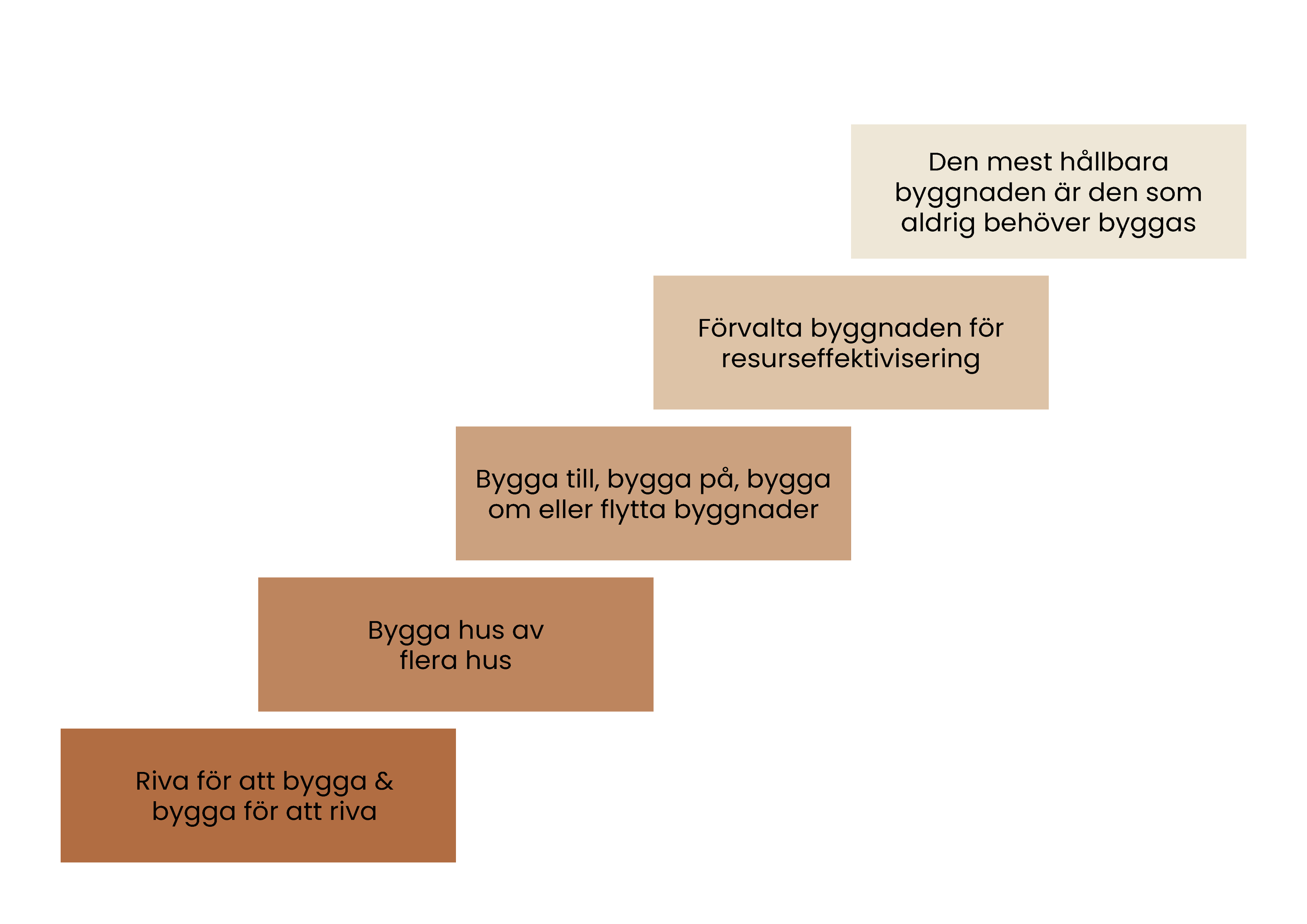
Figure: The property ladder by Robin Rushdi Al-sálehi 2025. Here the industry starts from the bottom, at the step "stop tearing down functioning buildings!".
Källa: https://www.vakansa.se/hallbarhet